In 1724, the French government issued the Code Noir or Black Code to regulate the relationships with blacks and whites in Louisiana.
Louisiana Code Noir 1724
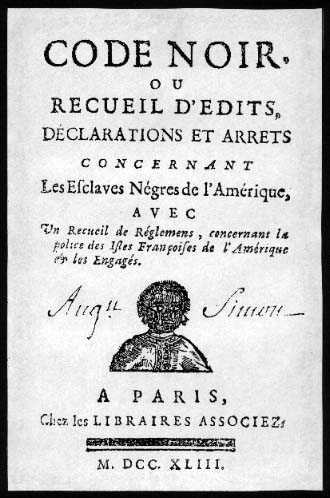
I. Decrees the expulsion of Jews from
the colony.
II. Makes it imperative on masters to
impart religious instruction to their slaves.
III. Permits the exercise of the Roman
Catholic creed only. Every other mode of worship is prohibited.
IV. Negroes placed under the direction
or supervision of any other person than a Catholic, are liable to confiscation.
V. Sundays and holidays are to be
strictly observed. All negroes found at work on these days are to be
confiscated.
VI. We forbid our white subjects, of
both sexes, to marry with the blacks, under the penalty of being fined and
subjected to some other arbitrary punishment. We forbid all curates, priests,
or missionaries of our secular or regular clergy, and even our chaplains in our
navy to sanction such marriages. We also forbid all our white subjects, and
even the manumitted or free-born blacks, to live in a state of concubinage with
blacks. Should there be any issue from this kind of intercourse, it is our will
that the person so offending, and the master of the slave, should pay each a
fine of three hundred livres. Should said issue be the result of the
concubinage of the master with his slave, said master shall not only pay the
fine, but be deprived of the slave and of the children, who shall be adjudged
to the hospital of the locality, and said slaves shall be forever incapable of
being set free. But should this illicit intercourse have existed between a free
black and his slave, when said free black had no legitimate wife, and should
said black marry said slave according to the forms prescribed by the church,
said slave shall be thereby set free, and the children shall also become free
and legitimate ; and in such a case, there shall be no application of the
penalties mentioned in the present article.
VII. The ceremonies and forms
prescribed by the ordinance of Blois, and by the edict of 1639, for marriages,
shall be observed both with regard to free persons and to slaves. But the
consent of the father and mother of the slave is not necessary; that of the
master shall be the only one required.
VIII. We forbid all curates to proceed
to effect marriages between slaves without proof of the consent of their
masters; and we also forbid all masters to force their slaves into any marriage
against their will.
IX. Children, issued from the marriage
of slaves, shall follow the condition of their parents, and shall belong to the
master of the wife and not of the husband, if the husband and wife have
different masters.
X. If the husband be a slave, and the
wife a free woman, it is our will that their children, of whatever sex they may
be, shall share the condition of their mother, and be as free as she,
notwithstanding the servitude of their father; and if the father be free and
the mother a slave, the children shall all be slaves.
XI. Masters shall have their Christian
slaves buried in consecrated ground.
XII. We forbid slaves to carry
offensive weapons or heavy sticks, under the penalty of being whipped, and of
having said weapons confiscated for the benefit of the person seizing the same.
An exception is made in favor of those slaves who are sent a hunting or a
shooting by their masters, and who carry with them a written permission to that
effect, or are designated by some known mark or badge.
XIII. We forbid slaves belonging to
different masters to gather in crowds either by day or by night, under the
pretext of a wedding, or for any other cause, either at the dwelling or on the
grounds of one of their masters, or elsewhere, and much less on the highways or
in secluded places, under the penalty of corporal punishment, which shall not
be less than the whip. In case of frequent offences of the kind, the offenders
shall be branded with the mark of the flower de luce, and should there be
aggravating circumstances, capital punishment may be applied, at the discretion
of our judges. We command all our subjects, be they officers or not, to seize
all such offenders, to arrest and conduct them to prison, although there should
be no judgment against them.
XIV. Masters who shall be convicted of
having permitted or tolerated such gatherings as aforesaid, composed of other
slaves than their own, shall be sentenced, individually, to indemnify their
neighbors for the damages occasioned by said gatherings, and to pay, for the first
time, a fine of thirty livres, and double that sum on the repetition of the
offence.
XV. We forbid negroes to sell any
commodities, provisions, or produce of any kind, without the written permission
of their masters, or without wearing their known marks or badges, and any
persons purchasing any thing from negroes in violence of this article, shall be
sentenced to pay a fine of 1500 livres.
XVI, XVII, XVIII, XIX, provide at
length for the clothing of slaves and for their subsistence.
XX. Slaves who shall not be properly
fed, clad, and provided for by their masters, may give information thereof to
the attorney-general of the Superior Council, or to all the other officers of
justice of an inferior jurisdiction, and may put the written exposition of their
wrongs into their hands ; upon which information, and even ex officio, should
the information come from another quarter, the attorney-general shall prosecute
said masters without charging any costs to the complainants. It is our will
that this regulation be observed in all accusations for crimes or barbarous and
inhuman treatment brought by slaves against their masters.
XXI. Slaves who are disabled from
working, either by old age, disease, or otherwise, be the disease incurable or
not, shall be fed and provided for by their masters ; and in case they should
have been abandoned by said masters, said slaves shall be adjudged to the
nearest hospital, to which said masters shall be obliged to pay eight cents a
day for the food and maintenance of each one of these slaves ; and for the
payment of this sum, said hospital shall have a lien on the plantations of the
master.
XXII. We declare that slaves can have
no right to any kind of property, and that all that they acquire, either by
their own industry or by the liberality of others, or by any other means or
title whatever, shall be the full property of their masters ; and the children
of said slaves, their fathers and mothers, their kindred or other relations,
either free or slaves, shall have no pretensions or claims thereto, either
through testamentary dispositions or donations inter vi-vos ; which
dispositions and donations we declare null and void, and also whatever promises
they may have made, or whatever obligations they may have subscribed to, as
having been entered into by persons incapable of disposing of any thing, and of
participating to any contract.
XXIII. Masters shall be responsible
for what their slaves have done by their command, and also for what
transactions they have permitted their slaves to do in their shops, in the
particular line of commerce with which they were intrusted ; and in case said
slaves should have acted without the order or authorization of their masters,
said masters shall be responsible only for so much as has turned to their profit;
and if said masters have not profited by the doing or transaction of their
slaves, the pcculium which the masters have permitted the slaves to own, shall
be subjected to all claims against said slaves, after deduction made by the
masters of what may be due to them ; and if said peculium should consist, in
whole or in part, of merchandises in which the slaves had permission to
traffic, the masters shall only come in for their share in common with the
other creditors.
XXIV. Slaves shall be incapable of all
public functions, and of being constituted agents for any other person than
their own masters, with powers to manage or conduct any kind of trade ; nor can
they serve as arbitrators or experts; nor shall they be called to give their
testimony either in civil or in criminal cases, except when it shall be a
matter of necessity, and only in default of white people ; but in no case shall
they be permitted to serve as witnesses either for or against their masters.
XXV. Slaves shall never be parties to
civil suits, either as plaintiffs or defendants, nor shall they be allowed to
appear as complainants in criminal cases, but their masters shall have the
right to act for them in civil matters, and in criminal ones, to demand punishment
and reparation for such outrages and excesses as their slaves may have suffered
from.
XXVI. Slaves may be prosecuted
criminally, without their masters being made parties to the trial, except they
should be indicted as accomplices; and said slaves shall be tried, at first, by
the judges of ordinary jurisdiction, if there be any, and on appeal, by the
Superior Council, with the same rules, formalities, and proceedings observed
for free persons, save the exceptions mentioned hereafter.
XXVII. The slave who, having struck
his master, his mistress, or the husband of his mistress, or their children,
shall have produced a bruise, or the shedding of blood in the face, shall
suffer capital punishment.
XXVIII. With regard to outrages or
acts of violence committed by slaves against free persons, it is our will that
they be punished with severity, and even with death, should the case require
it.
XXIX. Thefts of importance, and even
the stealing of horses, mares, mules, oxen, or cows, when executed by slaves or
manumitted persons, shall make the offender liable to corporal, and even to
capital punishment, according to the circumstances of the case.
XXX. The stealing of sheep, goats,
hogs, poultry, grain, fodder, peas, beans, or other vegetables, produce, or provisions,
when committed by slaves, shall be punished according to the circumstances of
the case ; and the judges may sentence them, if necessary, to be whipped by the
public executioner, and branded with the mark of the flower de luce.
XXXI. In cases of thefts committed or
damages done by their slaves, masters, besides the corporal punishment
inflicted on their slaves, shall be bound to make amends for the injuries
resulting from the acts of said slaves, unless they prefer abandoning them to
the sufferer. They shall be bound so to make their choice, in three days from
the time of the conviction of the negroes ; if not, this privilege shall be
forever forfeited.
XXXII. The runaway slave, who shall
continue to be so for one month from the day of his being denounced to the
officers of justice, shall have his ears cut off, and shall be branded with the
flower de luce on the shoulder : and on a second offence of the same nature,
persisted in during one month from the day of his being denounced, he shall be hamstrung,
and be marked with the flower de luce on the other shoulder. On the third
offence, he shall suffer death.
XXXIII. Slaves, who shall have made
themselves liable to the penalty of the whip, the flower de luce brand, and ear
cutting, shall be tried, in the last resort, by the ordinary judges of the
inferior courts, and shall undergo the sentence passed upon them without there
being an appeal to the Superior Council, in confirmation or reversal of
judgment, notwithstanding the article 26th of the present code, which shall be
applicable only to those judgments in which the slave convicted is sentenced to
be hamstrung or suffer death.
XXXIV. Freed or free-born negroes, who
shall have afforded refuge in their houses to fugitive slaves, shall be
sentenced to pay to the masters of said slaves, the sum of thirty livres a day
for every day during which they shall have concealed said fugitives ; and all
other free persons, guilty of the same offence, shall pay a fine of ten livres
a day as aforesaid ; and should the freed or free-born negroes not be able to
pay the fine herein specified, they shall be reduced to the condition of
slaves, and be sold as such. Should the price of the sale exceed the sum
mentioned in the judgment, the surplus shall be delivered to the hospital.
XXXV. We permit our subjects in this
colony, who may have slaves concealed in any place whatever, to have them
sought after by such persons and in such a way as they may deem proper, or to
proceed themselves to such researches, as they may think best.
XXXVI. The slave who is sentenced to
suffer death on the denunciation of his master, shall, when that master is not
an accomplice to his crime, be appraised before his execution by two of the
principal inhabitants of the locality, who shall be especially appointed by the
judge, and the amount of said appraisement shall be paid to the master. To
raise this sum, a proportional tax shall be laid on every slave, and shall be
collected by the persons invested with that authority.
XXXVII. We forbid all the officers of
the Superior Council, and all our other officers of justice in this colony, to
take any fees or receive any perquisites in criminal suits against slaves,
under the penalty, in so doing, of being dealt with as guilty of extortion.
XXXVIII. We also forbid all our
subjects in this colony, whatever their condition or rank may be, to apply, on
their own private authority, the rack to their slaves, under any pretence
whatever, and to mutilate said slaves in any one of their limbs, or in any part
of their bodies, under the penalty of the confiscation of said slaves ; and
said masters, so offending, shall be liable to a criminal prosecution. We only
permit masters, when they shall think that the case requires it, to put their
slaves in irons, and to have them whipped with rods or ropes.
XXXIX. We command our officers of
justice in this colony to institute criminal process against masters and
overseers who shall have killed or mutilated their slaves, when in their power
and under their supervision, and to punish said murder according to the
atrocity of the circumstances; and in case the offence shall be a pardonable
one, we permit them to pardon said masters and overseers without its being
necessary to obtain from us letters patent of pardon. XL. Slaves shall he held
in law as movables, and as such, they shall be part of the community of
acquests between husband and wife ; they shall not be liable to be seized under
any mortgage whatever; and they shall be equally divided among the co-heirs
without admitting from any one of said heirs any claim founded on preciput or
right of primogeniture, or dowry.
XLI, XLII. Are entirely relative to
judicial forms and proceedings.XLIII. Husbands and wives shall not be seized
and sold separately when belonging to the same master : and their children,
when under fourteen years of age, shall not be separated from their parents,
and such seizures and sales shall be null and void. The present article shall
apply to voluntary sales, and in case such sales should take place in violation
of the law, the seller shall be deprived of the slave he has illegally
retained, and said slave shall be adjudged to the purchaser without any
additional price being required.
XLIV. Slaves, fourteen years old, and
from this age up to sixty, who are settled on lands and plantations, and are at
present working on them, shall not be liable to seizure for debt, except for
what may be due out of the purchase money agreed to be paid for them, unless
said grounds or plantations should also be distressed, and any seizure and
judicial sale of a rea,l estate, without including the slaves of the aforesaid
age, who are part of said estate, shall be deemed null and void.
XLV, XLVI, XLVII, XLVIII, XLIX. Are
relative to certain formalities to be observed in judicial proceedings.
L. Masters, when twenty-five years
old, shall have the power to manumit their slaves, cither by testamentary
dispositions, or by acts inter vivos. But, as there may be mercenary masters
disposed to set a price on the liberation of their slaves ; and whereas slaves,
with a view to acquire the necessary means to purchase their freedom, may be
tempted to commit theft or deeds of plunder, no person, whatever may he his
rank and condition, shall be permitted to set free his slaves, without
obtaining from the Superior Council a decree of permission to that effect ;
which permission shall be granted without costs, when the motives for the
setting free of said slaves, as specified in the petition of the master, shall
appear legitimate to the tribunal. All acts for the emancipation of slaves,
which, for the future, shall be made without this permission, shall be null ;
and the slaves, so freed, shall not be entitled to their freedom ; they shall,
on the contrary, continue to be held as slaves; but they shall be taken away
from their former masters, and confiscated for the benefit of the India
Company. LI. However, should slaves be appointed by their masters tutors to
their children, said slaves shall be held and regarded as being thereby set
free to all intents and purposes.
LII. We declare that the acts for the
enfranchisement of slaves, passed according to the forms above described, shall
be equivalent to an act of naturalization, when said slaves are not born in our
colony of Louisiana, and they shall enjoy all the rights and privileges
inherent to our subjects born in our kingdom or in any land or country under
our dominion. We declare, therefore, that all manumitted slaves, and all
free-born negroes, are incapable of receiving donations, either by testamentary
dispositions, or by acts inter vivos from the whites. Said donations shall be
null and void, and the objects so donated shall be applied to the benefit of
the nearest hospital.
LIII. We command all manumitted slaves
to show the pro foundest respect to their former masters, to their widows and
children, and any injury or insult offered by said manumitted slaves to their
former masters, their widows or children- shall be punished with more severity
than if it had been offered to any other person. We, however, declare them exempt
from the discharge Of all duties or services, and from the payment of all taxes
or fees, or any thing else which their former masters might, in their quality
of patrons, claim either in relation to their persons, or to their personal or
real estate, either during the life or after the death of said manumitted
slaves.
LIV. We grant to manumitted slaves the
same rights, privileges, and immunities which are enjoyed by free-born persons.
It is our pleasure that their merit in having acquired their freedom, shall
produce in their favor, not only with regard to their persons, but also to
their property, the same effects which our other subjects derive from the happy
circumstance of their having been born free.
In the name of the King,
Bienville, De la Chaise.
Fazende, Bruslé, Perry, March, 1724.
Source:
B. F. French, Historical Collections
of Louisiana: Embracing Translations of Many Rare and Valuable Documents
Relating to the Natural, Civil, and Political History of that State (New York:
D. Appleton, 1851)
